
Responsible Gambling Resources
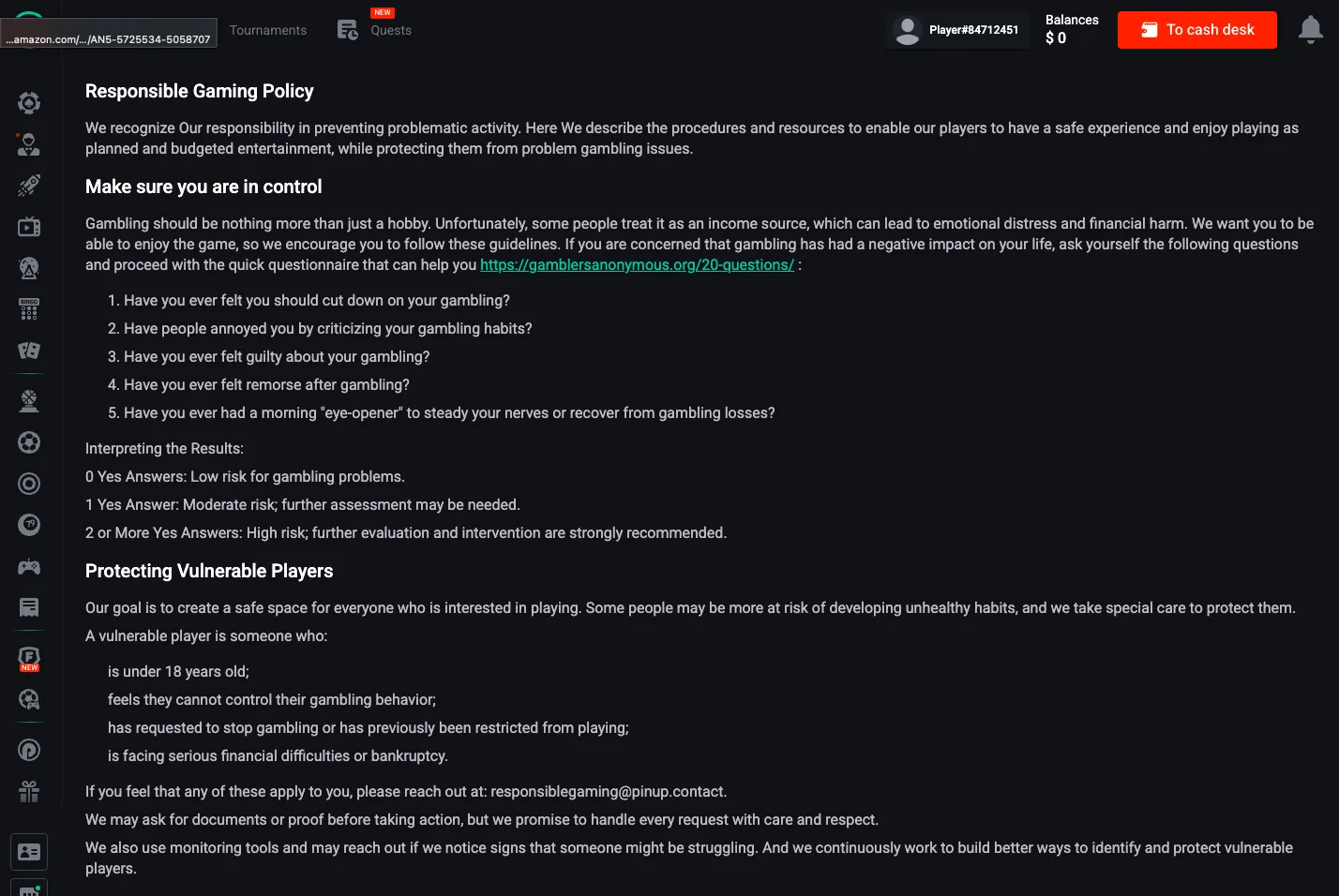
Gambling is meant to be entertainment, not a financial strategy or an emotional escape. If it stops feeling like entertainment, it's time to step back. This page lists the warning signs, the tools Pin Up provides for setting limits or excluding yourself, and the international and regional helplines you can reach for support. None of this is preachy — it's a practical guide for keeping your relationship with the app healthy.
Signs Your Gambling May Be a Problem
Gambling problems usually develop gradually. Common warning signs include:
- Spending more time or money on gambling than you planned
- Chasing losses with bigger bets to recover what you lost
- Borrowing money or selling things to fund gambling
- Lying to family or friends about how much you gamble
- Neglecting work, family, or social commitments because of gambling
- Feeling anxious, irritable, or depressed when not gambling
- Trying to stop and being unable to
If any of these resonate, talk to one of the helplines listed below. They're free, confidential, and staffed by people trained to help — not judge.
Self-Exclusion on Pin Up
Pin Up provides several built-in tools that let you set hard limits on your account or temporarily exclude yourself from playing.
Deposit Limits
Profile → Responsible Gambling → Deposit Limits. You can set a daily, weekly, or monthly cap on how much you deposit. Once set, the limit is enforced server-side — you can't bypass it by uninstalling and reinstalling the app. Increasing a limit takes a 24-hour cooling-off period before it activates; decreasing takes effect immediately.
Loss Limits
Same menu, separate setting. Caps your net losses (deposits minus withdrawals) over a chosen window. When you hit the limit, the app blocks new bets until the window resets. Useful if you tend to chase losses.
Session Time Limits
Sets a maximum continuous session length. After your set time, the app logs you out and requires a cooling-off period before you can log back in. Useful for breaking the "just one more spin" loop.
Self-Exclusion (Cool-Off)
Temporarily lock yourself out of the account for 24 hours, 7 days, 1 month, 6 months, or permanent self-exclusion. Once activated, support cannot reverse the cool-off until the period ends. Permanent self-exclusion is final — not reversible.
To activate any of these tools: open the Pin Up app, tap your profile icon, scroll to Responsible Gambling, choose the tool, and confirm. Takes 30 seconds.
Why APK users need a stricter safety routine
This site is about downloading and using an app, which adds a layer that normal casino responsible-gambling pages often skip: device behavior. If the app lives on your home screen next to WhatsApp, Telegram, and banking apps, access becomes frictionless. Frictionless access is convenient when you are in control and dangerous when you are not. That is why APK users should build one more layer of discipline than browser-only players: not just bankroll limits, but device-level limits too.
In practical terms, that means deciding in advance whether you want the app to be immediately reachable at all times. If the answer is no, keep it out of the first home-screen row, disable promotional notifications, and use Android's Digital Wellbeing timer to hard-stop access after your planned session length. These are not cosmetic changes. They turn impulsive reopening into a conscious action, and that pause matters more than most players realize.
A practical “safe install” routine
If you want a cleaner setup, use this sequence. First, set your deposit limit before the first deposit. Second, install the APK only from the operator domain you intended to use; do not keep mirror APKs or forwarded files in your downloads folder. Third, disable bonus and cashback push notifications unless you explicitly rely on them. Fourth, add a screen-time or app-timer limit at the device level. Fifth, decide what event ends a session: a fixed time, a fixed loss, or a fixed win-withdraw point.
That routine sounds basic, but it solves the exact pattern that turns “I just wanted the app for convenience” into repeated unplanned sessions. Good responsible-gambling advice is not only about crisis response. It is about making relapse and chasing harder than they would be by default.
International Helplines
These services are free, confidential, and run by trained counselors who specialize in gambling-related support.
- BeGambleAware (UK, global English-speaking) — 24/7 chat and phone support. begambleaware.org | Phone: 0808 8020 133 (UK)
- GamCare (UK) — National Gambling Helpline. gamcare.org.uk | Phone: 0808 8020 133
- Gambling Therapy (international) — Support in multiple languages including Hindi, Portuguese, and Russian. gamblingtherapy.org
- Gamblers Anonymous (worldwide) — Peer support meetings. gamblersanonymous.org
Regional Helplines
India
- iCall — Email and phone counseling. icallhelpline.org | Phone: +91 9152987821
- AASRA — Crisis helpline (broader than gambling). Phone: +91 9820466726
Brazil
- Jogadores Anônimos — Brazilian Gamblers Anonymous chapter. jogadoresanonimos.com.br
- CVV Brasil — Centro de Valorização da Vida (broader emotional support). Phone: 188
Bangladesh
- Kaan Pete Roi — Mental health helpline (broader than gambling). Phone: +880 9612119911
Kazakhstan
- Republican Mental Health Center — Available in Russian and Kazakh. Phone: +7 727 250 4000
Setting Up Healthy Habits
If you're not in crisis but want to keep things healthy, a few practical habits help:
- Set a deposit limit before you deposit, not after. Pick the amount you'd be okay losing entirely as entertainment cost. That's your budget.
- Time-box your sessions. 30 minutes, 60 minutes — whatever feels right. Use the session time limit feature.
- Don't chase losses. Variance swings both ways. Doubling down to "win back" what you lost is the most common path from entertainment to problem.
- Take regular breaks. A week off every month is a good rhythm.
- Talk about it. If you're hiding your gambling from people you trust, that's a flag.
What to do in the first 10 minutes if you think you are slipping
If you feel that familiar pull to deposit again, open the app again, or chase a bad session, do not start with a big life decision. Start with a short interruption sequence. Step 1: log out. Step 2: move the app off the home screen or uninstall it. Step 3: set a 24-hour cool-off or self-exclusion if you do not trust yourself to pause. Step 4: send one message to someone real or use one helpline on this page. Step 5: do not re-open gambling content “just to check something,” because checking often becomes re-entry.
The goal of that first 10 minutes is not to solve everything. It is to stop momentum. Most harmful gambling spirals are made of a lot of small unchallenged decisions, not one dramatic event. Breaking that momentum early is the most useful skill this page can give you.
If You Want the App Off Your Phone
If you've decided to stop, the cleanest path is: (1) activate permanent self-exclusion in the app, (2) uninstall the APK from your phone, (3) ask Pin Up support to close the account permanently. You can also use Android's Digital Wellbeing screen-time limits to block the Pin Up app at the device level. On iOS, the Screen Time app does the same.
This Is a Resource Page, Not a Sales Page
I keep this page updated because Pin Up's app exists in countries where regulated support infrastructure is sometimes thin. If you found a regional helpline that should be added, ping me on the blog Telegram channel and I'll include it. The goal is for anyone who lands on this page in a difficult moment to find a real human they can call.